Boutique vs Large Consultancy: What Actually Differs in Cybersecurity
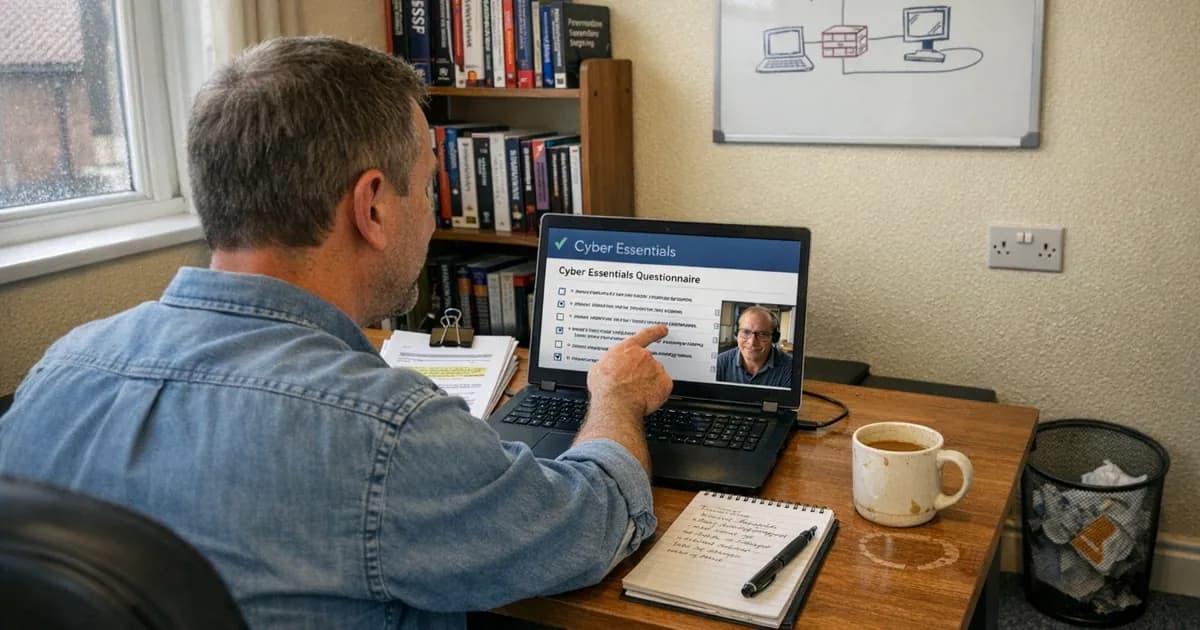
Boutique vs Large Consultancy: What Actually Differs
You can get Cyber Essentials certification from a large consultancy or a boutique firm, and the certificate looks the same either way. The difference is in who does the work, who you speak to when something goes wrong, and what you pay for the experience.
What happens at a large consultancy
Large consultancies sell Cyber Essentials as one product in a catalogue of hundreds. The salesperson who signs the deal isn't the person who does the assessment. The assessment is handed to an internal team or, more often, subcontracted to a third party. The subcontractor may not be an IASME Assessor themselves.
The client pays a project management layer, an account management layer, and then the actual assessment work underneath all of that. Some organisations pay GBP 3,000 to GBP 5,000 for Cyber Essentials with "hand-holding" included, where a consultant guides them through the questionnaire. The assessor who signs off the certification at the end may never have spoken to the client directly.
If the person certifying your business has never met you, never spoken to you, and could not explain why a specific control matters for your industry, that's not a cybersecurity service. It's a checkbox exercise with a premium price tag.
This does not mean large consultancies are bad at what they do. They exist because some organisations want a single vendor for everything, and the overhead is the price of that convenience. But for Cyber Essentials specifically, where the assessment is about your specific environment and your specific controls, having a direct relationship with the assessor matters.
What happens at a boutique firm
At a boutique cybersecurity firm, the person who answers the phone is often the same person who does the assessment. There is no handoff from sales to delivery. There is no account manager translating between the client and the technical team. The assessor who signs off the certification is the same person who asked the questions.
I've certified over 800 organisations through Cyber Essentials and CE Plus. Every assessment is done by a CREST-registered tester who knows every question in the Danzell framework. When a client calls with a question about whether their personal phone is in scope or how to handle a specific cloud service configuration, the answer comes from the assessor, not from a support desk reading from a script.
The standard market price for a CE assessment averages around GBP 1,200. You can see the actual CE assessment pricing and CE Plus pricing on the website. The price difference between boutique and large consultancy isn't a discount on quality. It's the absence of overhead that doesn't benefit the client.
What I see from the other side
I chose this model on purpose after working in environments where the assessment process involved four people, three of whom never touched the client's actual infrastructure. The account manager sold the engagement, the project manager scheduled it, and the consultant ran the assessment. And then the account manager came back to present the findings, having read the report for the first time that morning.
That's not a broken model for every type of work. If you're running a six-month security transformation programme across a 2,000-person estate, you probably need those layers. Someone has to coordinate workstreams, manage dependencies, keep the board updated, and that's fine.
But Cyber Essentials isn't that type of work. It's a defined assessment against a defined standard. One assessor, one client, one set of controls. Adding three management layers to that process doesn't make the assessment more thorough. It makes it more expensive and slower.
I built Net Sec Group around the idea that the person who does the work is the person you talk to. When I find something that doesn't meet the standard, I explain it directly. I don't write it in a report that gets filtered through a project manager who translates it for an account manager who then relays a softened version back to you. You hear it from me, in plain language, with the specific fix attached.
That's not because I think I'm better than anyone at a large consultancy. It's because the work itself doesn't need layers. And those layers cost money that could be spent on actually improving your security.
The assessor relationship matters
There's a practical reason the direct relationship makes a difference, and it goes beyond convenience.
During a CE assessment, questions come up that aren't in the documentation. You've got a cloud service that sits in a grey area for scope. Your BYOD policy covers phones but not tablets. Your firewall rules were configured by someone who left the business two years ago and nobody's entirely sure what some of them do. These are real situations that come up in assessments regularly.
When the person answering those questions is the same person who runs the assessment and signs off the certification, you get a definitive answer. Not "I'll check with the technical team and get back to you." Not "I'll raise that with the assessor." The answer comes from the person whose name goes on the certificate.
That matters even more when something is wrong. I've had assessments where a client's patching was months behind on a set of devices they'd forgotten about. The conversation about what needs fixing, how quickly, and what the actual risk is happens directly. Nobody is relaying messages or softening the language. If something is going to fail the assessment, you find out from the person who found it, and you get the specific steps to fix it in the same conversation.
The flip side is also true and equally important. When your setup is stronger than you expected, when you're actually doing four of the five controls already and you just need to tighten one thing, that reassurance means more coming from the assessor than from someone who's reading the assessor's notes.
The honest trade-offs
Boutique firms have real limitations and it would be dishonest to pretend otherwise.
A one-person firm has one person and one person only. If that person is ill, on holiday, or overloaded with assessments, the client waits. There is no backup assessor sitting in the next office. Response times depend entirely on capacity, and capacity has a ceiling.
A large consultancy has depth and bench strength. If your primary contact is unavailable, someone else picks up the work. They have larger teams for complex engagements, more industry certifications on the wall, and the brand recognition that some procurement departments require.
The question is whether those things matter for your specific situation. If you're a 50-person business getting Cyber Essentials certified, you need an assessor who understands your environment and can explain the requirements clearly. You don't need a consultancy that also does enterprise software implementation and cloud migration.
What to look for when choosing
Whether you choose boutique or large consultancy, the things that matter for Cyber Essentials are the same.
Who does the assessment? Ask whether the person doing the assessment is an accredited CE assessor or whether the work is subcontracted. If it's subcontracted, ask who the subcontractor is and check their accreditation.
Who signs off the certification? The person who signs the declaration should have reviewed your answers and understood your environment. Ask if you'll speak to them directly at any point during the process.
What happens when you have questions? During a CE assessment, questions come up. About scope, about specific controls, about whether a particular device or service is in or out. The speed and quality of those answers depends on whether you're talking to the assessor or to someone relaying messages.
What does the price include? Some firms charge separately for pre-assessment support, remediation guidance, and the assessment itself. Others include everything, so compare like for like.
Common mistakes when choosing a provider
The most common mistake I see is comparing day rates without comparing what's included. A provider quoting £400 per day looks cheaper than one quoting £500 per day. But if the £400 rate excludes report writing, excludes remediation guidance, and charges extra for a retest if you fail the first time, the total cost ends up higher. I've seen organisations pay more for two rounds of assessment from a cheap provider than they would have paid for one round from a provider that got it right the first time.
The second mistake is assuming that a bigger company means a better assessment. The Cyber Essentials standard is the same regardless of who assesses you. The IASME scheme requirements are the same. An experienced sole assessor is working against the identical standard as a team of 20 at a large consultancy. The certificate doesn't carry the assessor's brand on it. It carries the scheme and nothing else.
The third mistake is not asking who actually does the work. If you're paying a consultancy and the assessment is subcontracted to someone you've never spoken to, ask yourself what the consultancy is providing. If the answer is "project management and a brand name," decide whether that's worth the premium. For some organisations that premium is worth paying, but for most businesses going through CE, it isn't.
And the fourth mistake is choosing based on geography. Your assessor doesn't need to be in the same city as you. CE assessments are done remotely in almost every case. CE Plus involves some on-site work in certain cases, but even that's increasingly done through remote vulnerability scanning. Pick the assessor who knows the standard best, not the one with the nearest office.
Why CE is particularly well suited to boutique firms
Some types of cybersecurity work genuinely need large teams. A penetration test of a complex web application with a hundred API endpoints, running across multiple environments, with a two-week timeline and daily reporting to a CISO and a board, that's a team engagement. You need testers, a project manager, someone coordinating access and scope changes, someone reviewing findings before they go to the client.
Cyber Essentials isn't that type of work. The assessment covers five technical controls against a published standard. The question set is defined by IASME. The assessor reviews the client's self-assessment, verifies the answers, and for CE Plus, runs vulnerability scans and checks configurations against a sampling methodology. It's structured, bounded work with a defined scope.
One qualified assessor can do this faster and more consistently than a team, because there's no coordination overhead. I don't need to brief anyone on the client's setup. I don't need to wait for a project manager to schedule the next phase. I don't need to align calendars across three people. The client sends their questionnaire, I review it, I come back with questions or findings, and we get it sorted.
That's why I've been able to certify over 800 organisations through this process. It's not about working harder than anyone else. It's about removing the friction that doesn't add value. A CE assessment should take days, not weeks. When it takes weeks, the delays are almost never technical.
What this means for your decision
The right choice depends on what you actually need. If your organisation requires a specific brand name on the certificate for procurement reasons, or if your board will only sign off on a provider from an approved supplier list, a large consultancy may be the practical choice. That's a legitimate business constraint worth acknowledging.
If you want a direct relationship with the person assessing your security controls, if you want answers from the assessor rather than from someone relaying the assessor's notes, and if you'd rather not pay for management layers that don't touch the assessment itself, a boutique firm is likely a better fit.
Both will issue the same certificate against the same IASME standards. The difference is the experience of getting there, what you pay for it, and whether the person who knows your setup best is the same person who picks up the phone when you have a question six months after certification.
Not sure where to start with your assessment? Take our readiness quiz, get in touch, email [email protected], or call +44 20 3026 2904.
Related articles
- Cyber Essentials for Financial Advisors
- The HTTPS Padlock Doesn't Mean a Website Is Safe
- What to Expect on Cyber Essentials Assessment Day
- Danzell vs Willow: What Actually Changed in Cyber Essentials

Get cybersecurity insights delivered
Join our newsletter for practical security guidance, Cyber Essentials updates, and threat alerts. No spam, just actionable advice for UK businesses.
Related Guides
Free Cyber Insurance with Cyber Essentials: What You Get and How to Upgrade
Every Cyber Essentials certificate includes free £25,000 cyber insurance. Five major UK insurers use CE as a baseline. Exactly what is covered, the 80% claims reduction, and how to upgrade to £100K or £250K.
Cyber Essentials for Financial Services: FCA, DORA, and Scope
Financial services firms face overlapping regulatory expectations on cybersecurity. Cyber Essentials maps directly to FCA operational resilience rules. How.
Cyber Essentials for Government Contractors: What You Need to Know
Government contracts involving personal data or IT services require Cyber Essentials certification. Here is what the requirement means and how to meet it.
Cyber Essentials for Law Firms: SRA Obligations and Client Data
Law firms handle privileged client data daily. Cyber Essentials maps directly to your SRA obligations. What the certification covers and where firms fail.
Cyber Essentials vs ISO 27001: Which Certification Do You Need?
CE takes weeks and covers five technical controls. ISO 27001 takes months and covers your entire security management system. How to choose.
Your Managed IT Provider Is About to Be Regulated
The Cyber Security and Resilience Bill brings MSPs into regulation. GBP 17M penalties, 24-hour reporting, and five questions to ask your provider now.
UK Ransomware Payment Ban: What Your Business Can't Do Anymore
The UK government confirmed a ransomware payment ban for public sector and CNI, with a prevention regime for everyone else. What it means for your business.
Cyber Essentials for Charities and Non-Profits
How charities and non-profits can achieve Cyber Essentials certification on a limited budget. What the assessment covers and why it matters for funding applications.
Cyber Essentials for Schools and Academy Trusts
Schools and MATs face unique Cyber Essentials challenges: shared devices, outsourced IT, student networks, and legacy MIS systems. How to handle them.
Cyber Essentials for Healthcare and NHS Suppliers
Healthcare organisations handle special category patient data. Cyber Essentials maps directly to DSPT and NHS supply chain requirements. Where healthcare IT fails.
Ready to get certified?
Book your Cyber Essentials certification or check your readiness with a free quiz.