Cyber Essentials Plus for UK Retailers and Hospitality: PCI DSS Adjacency, EPOS Estate, and Brand-Protection Insurance
Cyber Essentials Plus for UK Retailers and Hospitality: PCI DSS Adjacency, EPOS Estate, and Brand-Protection Insurance
UK retailers and hospitality operators run a wider IT estate than most other sectors. The payment-card environment sits inside PCI DSS scope. The EPOS terminals live across multiple sites with vendor-managed and merchant-managed components. The customer-loyalty databases hold personal data attracting UK GDPR obligations. The supplier-portal integrations and B2B customer relationships add another layer of cyber expectation. Cyber Essentials Plus addresses the cyber-controls section of all of these, alongside the PCI DSS work scoped to the card-handling environment.
What follows is what each driver actually expects, where CE Plus and PCI DSS sit relative to each other, what the EPOS scoping conversation looks like, and how a retailer with multiple sites or a hospitality operator with a regional estate clears the assessment.
How CE Plus and PCI DSS sit relative to each other
PCI DSS is the security standard the payment-card industry requires for any organisation handling card data. The standard sets twelve high-level requirements across the cardholder-data environment. PCI DSS scope is set by the card-handling activities and the systems involved in those activities.
Cyber Essentials Plus is the UK government scheme covering five technical controls across the IT estate the firm scopes for the assessment. Cyber Essentials Plus scope is set by the assessment scoping conversation between the firm and the assessor.
The two standards overlap heavily on technical controls. Both expect firewalls, secure configuration, controlled user access, malware protection, and timely patching of high-severity vulnerabilities. The PCI DSS requirements go further on the cardholder-data environment specifically, with detailed expectations on encryption, key management, network segmentation, logging, and personnel security. The CE Plus requirements stay focused on the five core controls but apply them across the IT estate the firm scopes in.
For most retailers and hospitality operators, the practical answer is that both standards apply to different parts of the estate. PCI DSS scopes the cardholder-data environment. CE Plus scopes the broader IT estate covering EPOS administration, stock management, loyalty databases, supplier integrations, and the office IT systems. The two standards run alongside each other rather than as alternatives.
A retailer holding both has a complete cyber posture story. A retailer holding only PCI DSS has the card-handling environment covered but not the broader IT estate. A retailer holding only CE Plus has the broader IT estate covered but still needs PCI DSS for card handling.
The EPOS estate scoping question
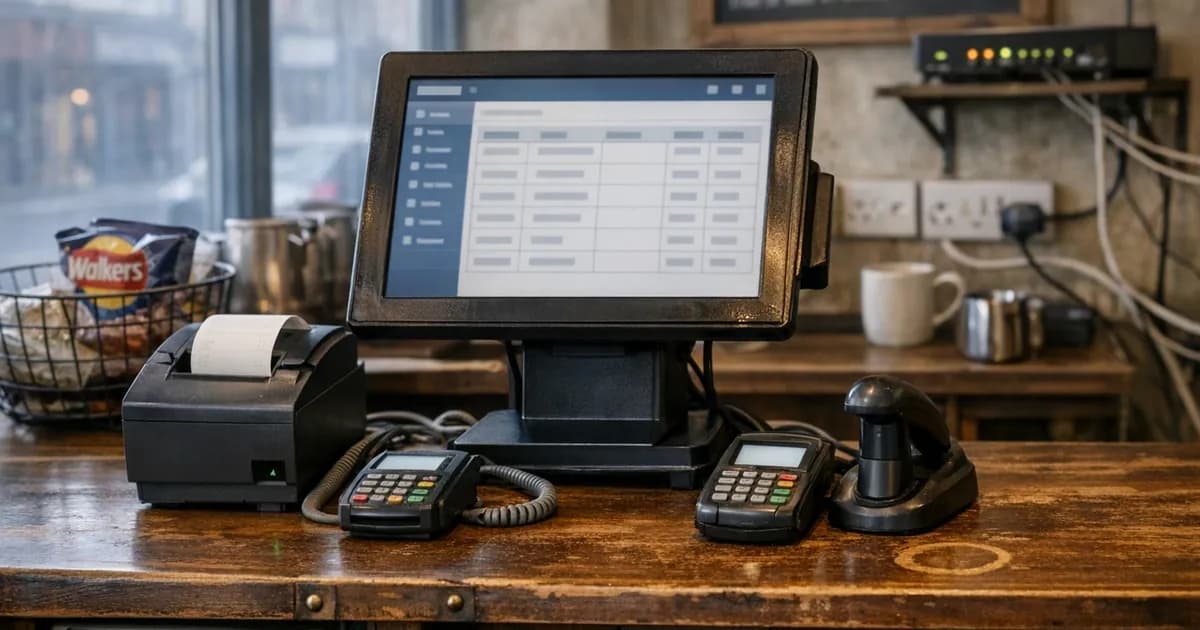
EPOS terminals are where the IT estate boundary becomes fuzziest in retail and hospitality.
A vendor-managed EPOS terminal running a closed software stack from the EPOS vendor, with no merchant-side administration access, often sits outside CE Plus scope as an appliance-style endpoint. The merchant has limited ability to patch, configure, or manage the device. The vendor's PCI DSS or equivalent attestation covers the device's compliance posture.
A merchant-managed EPOS terminal running a recognisable operating system (Windows POSReady, Linux, or similar) with merchant-side administration sits inside CE Plus scope. The merchant patches and configures the device under the firm's normal IT discipline. The CE Plus assessor samples the device to confirm those controls held in practice.
A hybrid EPOS estate, where some terminals are vendor-managed and others are merchant-managed, requires the scoping call to map the boundary clearly. The CE Plus assessment then covers the merchant-managed portion plus the boundary controls around the vendor-managed portion.
For multi-site retailers, the scoping decision adds a chain-level vs site-level dimension. A retailer with consolidated IT services and a uniform EPOS architecture across sites usually scopes at chain level, with one assessment covering the central infrastructure plus a sample across sites. A retailer where each site operates more independently usually scopes at site level. The architecture drives the right answer.
The first scan in a CE Plus engagement reveals the gap between what the IT provider and the EPOS vendor jointly manage and what the assessor will sample.
A pattern that turns up regularly across retail engagements: the back-office stock-management application is on a vendor release that was superseded six months ago, with a known high-severity vulnerability the retailer never applied because the upgrade required scheduling around the trading calendar and nobody owned the calendar. The IT provider applied OS patches and treated the retailer as patched. The application-layer gap sat outside the IT provider's scope until the assessor's report landed.
The fix is operational, not confrontational. The IT provider retains the desktop and Microsoft 365 work. The CE Plus assessor and the retailer agree the application-layer remediation owner for each finding. The operations director makes the operational call on the stock-management upgrade scheduling around the trading calendar. The certificate issues once the gap closes.
What B2B customer portals and supplier qualification want
For retailers and hospitality operators with B2B customer relationships (own-brand suppliers, white-label producers, foodservice supplying corporate clients), the B2B customer's procurement team often runs cyber due diligence on the merchant supplier as part of supplier qualification.
The questionnaire is the deliverable the merchant has to produce. The questions on it have settled into a recognisable pattern across the engagements we have run.
The certificate question always sits at the top. The questionnaire wants the certificate number, the issuing certification body, and the expiry date. A current CE Plus answers this in one line.
After the certificate comes multi-factor authentication. The questionnaire wants confirmation that MFA is enabled on every account with access to customer data, including the operations and account-management accounts. CE Plus assessment day samples the identity layer to confirm what is actually enrolled.
Patching cadence is next. The questionnaire wants to know whether the merchant holds patches inside the 14-day window across the order-management system, the stock system, and any customer-portal integration. The CE Plus assessment confirms the cadence held in practice.
The remaining questions move from technical controls into operational governance. The B2B customer wants a named incident-response contact, a documented response process, and evidence that the merchant assesses its own IT vendors. CE Plus does not directly assess incident response, but the operational discipline it requires usually sits next to a documented response process. CE Plus scope does include the merchant's third-party tools, which means the supplier-management question is partially answered by the certificate.
Where the answers land varies sharply by which certificate the merchant holds. With a current CE Plus, the cyber section of the supplier qualification closes on the certificate alone. With CE Basic, parts of it close. With neither, the merchant gets a long-form security audit from the B2B customer's cyber team, on a deadline that almost always came from procurement rather than from operations.
The brand-protection and cyber insurance angle
Cyber and brand-protection insurance renewals across UK retail and hospitality now include a cyber security section. The questions overlap with the B2B customer questionnaire because the insurer is pricing the same risk: the likelihood of a customer-data exposure, a payment-card environment compromise, or an operational disruption affecting trading, and the merchant's likely response when it happens.
Most insurers serving the retail and hospitality market now ask whether the merchant holds a Cyber Essentials or Cyber Essentials Plus certificate. Many give favourable consideration to merchants holding Plus. The specific premium adjustment varies by insurer and by merchant. The broker is the right person to confirm what a CE Plus certificate would mean for a specific renewal.
The honest framing is that CE Plus produces a documented, externally-verified statement of cyber controls that the insurer can evaluate against a known scheme. Insurers like known schemes because they reduce the underwriting friction. The premium effect, if any, sits downstream of that.
For brand-protection insurance specifically, the underwriting question often extends beyond the cyber controls into the merchant's wider operational and reputational exposure. CE Plus addresses the cyber-controls layer of that broader picture.
How CE Plus and Cyber 365 fit together
A CE Plus certificate is valid for 12 months. The trading calendar runs continuously. PCI DSS attestation runs annually for most merchant levels. B2B customer reviews land at unpredictable points across the year. The continuous-posture expectation across the retail and hospitality estate is implicit across all of these.
That continuous posture is what the Cyber 365 programme is for. Continuous vulnerability scanning runs against the same surface the assessor will check. Managed patching closes findings inside the 14-day window the scheme requires. The next assessment day becomes a check-in against an estate that has been kept in shape, not a recovery operation against a year of drift. (in line with the July 2024 assurance advisory).
For a retailer or hospitality operator, the combination is the closer fit. The certificate proves the controls were in place on assessment day. The continuous discipline proves they have stayed in place since, which matters when the next B2B customer review or PCI DSS attestation lands.
The Danzell assessment platform that came in April 2026 made year-round scanning and patching explicit in the Cyber Essentials scheme. Under the previous Marlin platform, the strict reading was that scanning at renewal could clear the patch-management control. Under Danzell, the scheme requires continuous discipline. The continuous-posture expectation that B2B customers and insurers already implied has now been written into the scheme rules the certificate sits inside.
Where to start
Book a 30-minute scoping call. We need the retailer or operator size, the EPOS architecture (vendor-managed vs merchant-managed split), the stock-management and loyalty-database application names, the current patching arrangement, whether multi-factor authentication is enabled across all accounts including operations and account-management accounts, and any B2B customer or insurance deadline if you have one. We come back with a written quote covering the CE Plus engagement and, if the merchant wants the year-round discipline added, the Cyber 365 programme alongside it.
For multi-site retailers, the scoping call confirms whether to assess at chain level or site level. For hospitality operators with regional estates, the same scoping decision applies.
The IASME £25,000 cyber insurance comes free with every Cyber Essentials certificate for qualifying UK SMEs under £20 million turnover. It is between the certified merchant and IASME. NetSec does not bundle, broker, or upsell it.
PCI DSS and Cyber Essentials Plus run alongside each other on the retailer or hospitality estate. PCI DSS scopes the cardholder-data environment. CE Plus scopes the broader IT estate. Cyber 365 produces the continuous discipline both standards expect between assessment days.

Get cybersecurity insights delivered
Join our newsletter for practical security guidance, Cyber Essentials updates, and threat alerts. No spam, just actionable advice for UK businesses.
Related Guides
Cyber Essentials Plus for NHS Suppliers: DSPT Alignment, Procurement Frameworks, and Patient-Data Confidentiality
NHS suppliers come to Cyber Essentials Plus through three doors: the Data Security and Protection Toolkit, the procurement frameworks NHS England and NHS Trusts run for IT and clinical-systems suppliers, and the patient-data confidentiality obligations under common law and the Caldicott principles. What CE Plus covers, what NHS procurement wants, and how a supplier with a tight contract deadline clears the assessment.
Cyber Essentials Plus for UK Accountancy Firms: ICAEW Standards, HMRC Data, and Client Mandate Cyber Reviews
UK accountancy firms hold HMRC-grade client data on every desktop. ICAEW and ICAS expect effective controls, corporate clients run cyber reviews on their auditors and tax advisers, and PI renewals ask increasingly specific cyber questions. What CE Plus covers, what reviewers want, and how a small partner-led firm with an outsourced MSP clears the assessment.
Cyber Essentials Plus for UK Charities: Trustee Accountability, Funder Requirements, and the Practical Path on a Tight Budget
UK charities face Cyber Essentials Plus from three directions: the Charity Commission's expectation that trustees protect charity assets, funders and grant-makers asking about cyber controls in funding applications, and donor-data confidentiality under UK GDPR. What CE Plus covers, what funders want, and how a charity with a small IT budget actually clears the assessment.
Cyber Essentials Plus for UK Construction: Main-Contractor Flow-Down, BIM Data Protection, and Project-Cyber Requirements
UK construction firms now meet Cyber Essentials Plus through main-contractor supply-chain flow-down, BIM and design data confidentiality on major projects, and the project-by-project cyber requirements that public-sector and large private clients now write into project documentation. What CE Plus covers, what main contractors want, and how a subcontractor or specialist firm clears the assessment.
Cyber Essentials Plus for UK Financial Services: FCA Operational Resilience, Third-Party Risk, and Client Mandate Requirements
FCA-regulated firms now meet Cyber Essentials Plus through three doors at once: operational resilience evidence for the regulator, cyber questionnaires from institutional clients, and increasingly specific PI and crime renewals. What the FCA expects, what the questionnaires want, and how a small in-house IT function clears the assessment.
Cyber Essentials Plus for UK Government Contractors: Central Government Framework, MoD Supply Chain, and OFFICIAL Data Handling
UK suppliers bidding for central government, local government, or MoD contracts now meet Cyber Essentials Plus as a baseline procurement requirement. CCS frameworks, PPN guidance, and Defence Cyber Protection Partnership all name the scheme. What CE Plus covers, what government procurement wants, and how a supplier with a tight bid deadline clears the assessment.
Cyber Essentials Plus for UK Law Firms: SRA Obligations, Client Confidentiality, and Panel Requirements
Law firms come to Cyber Essentials Plus through three doors: the SRA's accountability framework, panel-firm cyber questionnaires from corporate clients, and professional indemnity insurance renewals. What the scheme covers, what the regulator expects, and how a firm with a small IT function actually clears the assessment.
Cyber Essentials Plus for UK Manufacturers: Defence Supply Chain, Tier-1 Customer Audits, and OT/IT Convergence
UK manufacturers come to Cyber Essentials Plus through three doors: defence prime contractors flowing down DEFSTAN and JOSCAR cyber requirements, automotive and aerospace tier-1 customers running supplier cyber audits, and the operational-technology side of the business converging with the IT estate. What CE Plus covers, what tier-1 audits want, and how a manufacturing firm with mixed OT/IT scope clears the assessment.
Cyber Essentials Plus for UK Managed Service Providers: Why MSPs Hold the Certificate Their Customers Are About to Ask For
UK Managed Service Providers sit at the cyber supply-chain boundary for every customer they manage. Customers are now asking the MSP to evidence its own cyber posture before trusting the MSP with theirs. Cyber Essentials Plus is the artefact those customers want. What CE Plus covers for an MSP estate, what customer questionnaires want, and how an MSP whose own house is in disorder gets in shape.
Cyber Essentials Plus for UK Schools and MATs: DfE Digital Standards, Safeguarding Data, and the Governor Accountability Layer
UK schools and multi-academy trusts now meet Cyber Essentials Plus through the DfE Digital and Technology Standards, KCSIE safeguarding obligations, and the governor or trustee duty for school resources. What CE Plus covers across MIS, learning platforms, and safeguarding tools, and how a school with a small ICT budget actually clears the assessment.
Ready to get certified?
Book your Cyber Essentials certification or check your readiness with a free quiz.